
Manage program settings and your API key
Edit your program's terms after launch and find, copy, or regenerate the per-program API key that authenticates your tracking integration.
Everything you configured in the setup wizard stays editable after launch, and the same Settings page holds the API key that every server-side tracking call authenticates with. This guide shows where each setting lives, how to change terms safely, and how to rotate the key with the shortest possible gap in tracking.
What lives in Settings
Open your brand workspace and select Settings in the left menu. The page is organized as a checklist of sections:
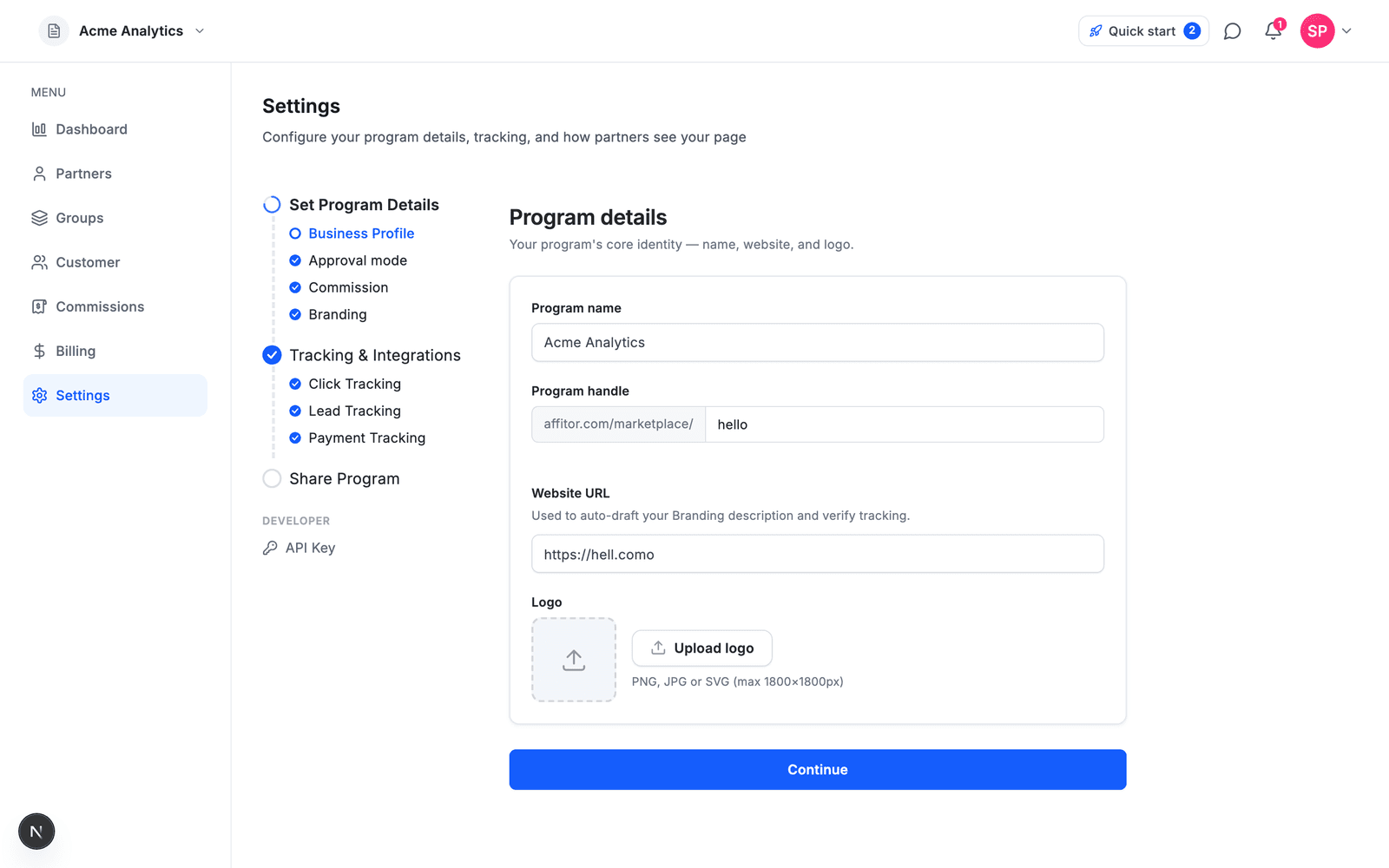
| Section | What you edit there |
|---|---|
| Business Profile | Program name, marketplace handle, website URL, logo |
| Approval mode | How partner applications are handled — manual review or auto-accept |
| Commission | Default commission type, rate, and hold period |
| Branding | How your program page looks to partners in the marketplace |
| Tracking & Integrations | Status of click, lead (signup), and payment tracking |
| Share Program | A shareable link for recruiting partners |
| API Key (under Developer) | The per-program secret key for server-side tracking calls |
Step 1: Edit program terms after launch
Programs evolve — rates get adjusted, branding gets refreshed, approval policies tighten or loosen. None of this requires recreating the program.
- Select Settings in the left menu of your brand workspace.
- Choose the section you want to change: Commission for the default rate and hold period, Approval mode to switch between manual review and auto-accept, Business Profile for the program name, website, and logo, or Branding for your marketplace page.
- Make the change and save the section.
The Commission section sets your program-wide default. To pay different rates to different sets of partners, organize partners into groups — each group carries its own commission policy.
Step 2: Find your API key
Every server-side call to the tracking API — sales, refunds, and server-mode leads — authenticates with a Bearer token that is unique to your program. Integrations, SDKs, the CLI's tracking setup, and AI agents all use this same key. CLI commands that create or list programs act as your account instead, and authenticate with your CLI login.
- Select Settings in the left menu.
- Under Developer, select API Key.
The dashboard displays the key masked, and no read returns the full value. It is revealed exactly once — in the response to an owner's Generate or Regenerate action on the API Key tab. If you no longer have the current key stored anywhere, you can't recover it from the dashboard; regenerate it instead (Step 3).
Store the key as a server-side environment variable:
# .env — server-side only. Never ship this key to the browser.
AFFITOR_API_KEY=YOUR_PROGRAM_API_KEYThe API Key section also gives you a one-line instruction for an AI coding agent. It points the agent at skill.md with your program ID and key variable, so the agent can install tracking for you — see Agent Integration.
Step 3: Regenerate the key
Rotate the key if it may have leaked, if it was committed to a repository, or as routine hygiene when a team member with key access leaves.
Only a workspace owner can regenerate a program key. A member who tries is refused, so ask an owner to run it and to hand you the new value through your secret manager.
The two keys never overlap. Regenerating replaces the key in place, and you receive the new value only in the regenerate response, so you cannot deploy it in advance. Between the regenerate and the redeploy, every integration still sending the old key gets 401 responses. Copy the new value before you close the reveal — it is shown one time only.
- Line up every place
AFFITOR_API_KEYis stored — deployment environment, secret manager, CI — so you can update them straight away. - In Settings → API Key, regenerate the key. The old key stops working at that moment.
- Copy the new key from the one-time reveal, update those places, and redeploy.
Verify it worked
Send a test-mode sale with the new key. It authenticates exactly like a real sale but creates no commission and no platform fee.
Request — POST /api/v1/track/sale:
curl -X POST https://api.affitor.com/api/v1/track/sale \
  -H "Authorization: Bearer YOUR_PROGRAM_API_KEY" \
  -H "Content-Type: application/json" \
  -d '{
    "additional_data": { "test_mode": true },
    "amount_cents": 9999,
    "currency": "USD",
    "sale_type": "payment"
  }'
Expected response:
{
  "success": true,
  "message": "Test sale event tracked successfully",
  "data": {
    "eventId": 789,
    "programId": 1,
    "test_mode": true
  }
}POST /api/v1/track/salewith the new key returns200and"success": true— the key authenticates- If you regenerated, the same request with the old key now returns
401— rotation is complete
- The test event appears under your program's tracking events, flagged as a test — no commission is created
- On a
401, readerror.codefirst.api_key_rotation_requiredmeans the key passed its rotation deadline — regenerate it and deploy the new value, because copying the same key again will not bring it back. Any other401means the header is malformed or the key matches no program — check theAuthorization: Bearerheader, check your env variable for trailing whitespace, and compare it against the full value you stored in your secret manager. If you no longer hold that value, ask an owner to regenerate the key (Step 3), copy it from the reveal, then update and redeploy - See the error reference for every
401cause and fix